

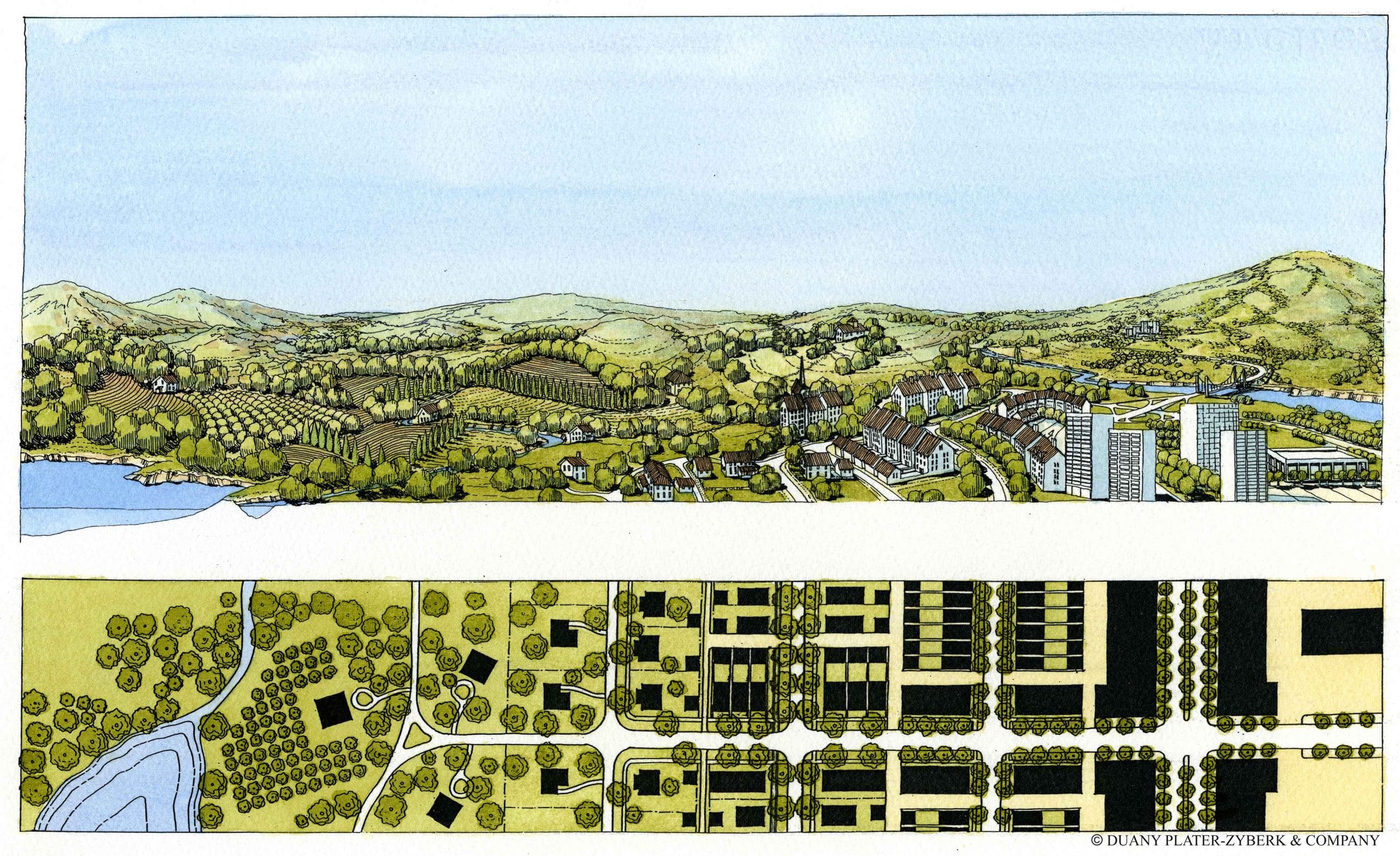
Agrarian Urbanism and the Long Precedent
People assume that what we are investing in at Hamlet is new. That could hardly be the case.
For nearly all of human history, people lived where the food grew. Settlements formed on floodplains and river deltas because that was where the soil was, and the village sat within walking distance of the fields that fed them.
It is only recently that homes have been separated from food. Refrigeration, rail, air, and the interstate system made it possible to live anywhere and eat from everywhere. Combined with single-use zoning—what we now know to be a disastrous urban planning precedent—we have created communities far removed from the lands that nourish us.
Ebenezer Howard proposed the first modern version of this in 1898, imagining satellite communities ringed by green belts and containing proportionate areas of housing, industry, and agriculture. Letchworth and Welwyn were built near London on that model. Howard’s insight was that town and country each had advantages the other lacked, and that a settlement could be designed to hold both.
Andrés Duany picked up the thread a century later. His 2011 book Garden Cities, written for the Prince’s Foundation, lays out what he calls agrarian urbanism, meaning settlements where the society is involved with food in all its aspects. Organizing it, growing it, processing it, distributing it, cooking it, eating it.
The distinction Duany draws is the useful part. Agrarian urbanism requires that the physical pattern of the settlement actually support an agrarian society, rather than simply placing houses near a farm. Where the streets run, how the lots are grouped, what sits at the center, whether the farmland is visible from the street. These decide whether people participate or merely spectate. These types of design approaches make enduring and successful projects, which we why we have chosen to incorporate an advisory arm to Hamlet’s business model as a way to steer best practices.
Moreover, Duany comes to agrarian urbanism from New Urbanism, which spent thirty years relearning how to build walkable places at human scale. The New Urbanist playbook had been to use compact development to contain sprawl and protect farmland by separating the two. Garden Cities moves the other way, toward towns scaled around agriculture rather than fenced off from it.
He also shares about what it takes. He argues that agrarian urbanism has to be profitable, popular, and reproducible to matter, and that it should use modern development, management, and marketing practice rather than romanticizing rural life. That is the sentence we keep coming back to. A beautiful idea that pencils once is a demonstration project. The work is making it repeatable, and it’s what we are excited to dedicate ourselves to at Hamlet.